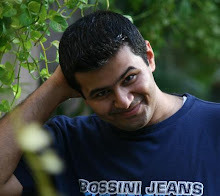
Who : Vinay Pathak
About : Great actor, former channel [V] VJ
Website: http://en.wikipedia.org/wiki/Vinay_Pathak
You can check out the interview HERE : Interview with Vinay Pathak
Interview Date: June 10, 2007
Place: Mayor's Bungalow, Mumbai
Pics: Various Celebs, Mumbai '07
Here I'm going to recollect how the interview with Vinay Pathak happened and describe the entire experience of the interview.
-------- To Be Updated --------
Showing posts with label Aaja Nachle. Show all posts
Showing posts with label Aaja Nachle. Show all posts
Wednesday, December 19, 2007

INTERVIEW WITH VINAY PATHAK - II
Who : Vinay Pathak
About : Great actor, former channel [V] VJ
Website: http://en.wikipedia.org/wiki/Vinay_Pathak
How it happened : Interview with Vinay Pathak
Interview Date: June 10, 2007
Place: Mayor's Bungalow, Mumbai
Pics: Various Celebs, Mumbai '07
About : Great actor, former channel [V] VJ
Website: http://en.wikipedia.org/wiki/Vinay_Pathak
How it happened : Interview with Vinay Pathak
Interview Date: June 10, 2007
Place: Mayor's Bungalow, Mumbai
Pics: Various Celebs, Mumbai '07
Nikhil Taneja (NT) : You were amongst the top five in your class at the business school you attended. What made you change your course and take up drama?
Vinay Pathak (VP): I went to see a play called Equs by Peter Sheafer. And I hold that play responsible, because after that I didn’t wanna do anything but theatre. And I joined drama school. I quit business school and ever since I’ve been corrupted.
NT: You and Ranvir Sheroy have changed the way Veejays are perceived, from the “Yo” dudes to cool dudes who are more than just eye candy. How easy or difficult was it for you to make it to Channel [V] and then take it by storm with your own brand of veejaying?
VP: I auditioned. I was auditioning all around, I even auditioned for MTV at that time. Channel [V] liked my audition. They called me. They offered me a show. I did the show for a week without Ranvir and then Ranvir and I got together and they said let’s try this comic duo thing and we did it and we had fun. We were just being ourselves. I don’t think we sat down and said, “Guidelines to change the course of Veejaying”. I don’t think that was in our plans. I don’t think we were even very serious about being a Veejay. Because that’s when this whole “Yo” thing comes in. I don’t think I was a “Yo” and neither was Ranvir. It’s not in the part of our personality and that’s what it was. Very simple. We were just being ourselves.
NT: What do you have to say about the current batch of veejays? Who is your most and least favourite?
VP: Uhh.. please forgive me but I do not watch television anymore, yaar. I seriously don’t. I don’t have any cable at home; for the last one year, I’ve got my cable cut. I’ve got two little daughters, 4 years and 2 years. For them, I cut the cable because, I mean, they don’t know how to control and screen what they are watching!
NT: You conceptualized Hip Hip Hurray, which was quite a hit TV show in its time. Can the viewers expect any more gems from you on TV in the near future?
VP: Any gems? (laughs). I’m writing a film, a friend of mine is directing that. On television we are doing Cricket Crazy and there might be something else coming up soon, something interesting. But yeah, there are a lot of movies happening. And writing wise, I’m writing another film, which would be for myself. I am gonna keep an open audition. You know, in the west, they do an open house. It’s like you have a huge house, and you wanna sell it, ok? So what you do is you do an open house. You do your house up and clean it and make it look blah-blah and you keep the snacks and the drinks and blah blah blah. And you invite all the realtors in the area. And they come and just check the house out and have a glass of wine and listen to the music and have the snacks and then go away. The whole day. They keep it the whole day. What that does is that open house creates a buzz in that area, that that house is for sale and what a fantastic house that is. So what I’m gonna do is I’m gonna keep an open audition for my film.
I can’t tell you anything about the movie because it’s still a work in progress and I think it’s unfair to the story because it’s still being developed. And when you talk about it in the media, somewhere, subconsciously, the subtext is to promote that story, which I wouldn’t want to do right now because the story’s not complete. You know what I mean? This film I’m writing right now, with Ranvir Shorey, is my friend Shashant Shah’s, who has also been directing Comedy Show all this while. We’ve been friends for a long time and we are partners in company as well. And he’ll be directing this film. The one that I want to direct is something that I’ve been working on for quite sometime. That’s something that I can’t talk about as well.
NT: Not many people know you have directed a short film called “Fourplay”. Tell us something more about it.
VP: Yes I have directed Fourplay, any problem? (laughs)Not many people need to know about it! It’s fiction. It’s an eleven minute feature that I wrote, produced and directed. It was great fun. It’s not a comedy, it’s a very poignant story. It’s a film with four actors, and hence Fourplay. And these four actors are playing four different characters in the first segment of the film and in the second segment. So there is a reflective parallel storyline kind of a film.
NT: How far do you think your show, Kahani Poori Filmi Hai helped you in getting recognized in the big league?
VP: I don’t think Kahaani Poori Filmi Hai was a show that was about that, what you just asked. I think that was a show which is very close to my heart, and also very close to my director’s heart, who also conceptualized the show, and who is Shashant Shah, by the way. So my association with him has been for a long time. We’ve been friends since Channel [V] days. When we started working together, we realized that certain aspirations that both of us had cinematically, had lots of similarity, they reflected each other somewhere. That’s why we decided to come together or work together. And that was my first association with Shashant. And I had a great time. So I don’t think that show was about getting recognized, it was more about discovering my love for Hindi Cinema.
It was a very good show. I don’t think it was solely because of me. I think it was also because the concept was huge. The guy who wrote it, you know, he is another very dear friend of mine, he was very good at the research and at the way he created that style and it was directed very well. And, on top of that, we all used to have a great time! Because we were all movie buffs. It used to transfer my back to my childhood when I would watch a movie Don and come out and walk like Amitabh Bachchan. And where am I going? I am going to take a leak! In the bathroom. And then I am just going and I am opening like Amitabh Bachchan, and then I am coming back and then I just look up and I realize that everybody is f***in walking like Amitabh Bachchan. That’s the craziness, that’s the madness and at the same time, that’s the power and fascination of Hindi cinema, which is fantastic. And that’s what we tried to bring in. The curiosity and the fun and the play of the kids, which is very childlike, you know, to fall in love with an actor, with a story and start to idolize. I mean, Graceland is
NT: You auditioned for Khurana’s role in Khosla Ka Ghosla which later went to Boman Irani. But I believe Asif Iqbal’s role was specially coined for you? What’s the story behind this?
VP: The story is very simple. Divakar read me for Khurana and I read Khurana in a specific way. And he was talking to Boman Irani simultaneously as well. And I remember him telling me that he wanted that contrasting body structure as well. Boman and then Anupamji, you know. There is a physical disparity as well. When Boman stands, it’s almost like he wants to eat the timid, shy, middle class Anupam Kher of Khosla. So when I read for Khurana he liked it but as I said there is a vision a director has, and I respect that. And after that he called me and said that I’m really sorry and I was looking at Boman and it works for me BUT I want to meet you again and he met me again and said that when you were doing that, I thought of Asif. And I said great, because it was a great ensemble!
NT: Now let’s talk about Bheja Fry, which has got you rave critical reviews from all over. Did you expect a movie made in 19 days flat would become such a box office success? How do you feel now that it has?
VP: No!! (groans) Let’s not! Everyone talks about Bheja Fry!! (laughs) Okay, let’s. I am still shocked. Such a small film creates such a stir, shocking. I still don’t know how it happened. But there a lot of things that you don’t know how they happen, like there is a guy called Rajiv and he has a friend. And I don’t know how that happens! Because I think the one thing that Bheja Fry proved to me is that you can’t predict. You can’t really know and predict that this is how you make a hit film.
NT: You were also credited with dialogue in the movie. Did you write only for your character or contributed to others as well?
VP: It was all improvisation that Rajat and I had. We had loads of those moments in the film. The bag moment, redial, etc. It’s not that we sat and wrote it, we created them and said them.
NT: You have acted in the Oscar Nominated Water also and I believe you have also done a Canadian film called Partition. How has the experience been working with international cast and crews? Any more international movies in the pipeline?
VP: Very good. They are very meticulous about their work. They are very orderly when it comes to even sneezing. So it’s good to sneeze on the sets. It’s good fun! Water, specially, because I have worked in Deepa’s first film, Fire and Deepa had become a friend. Very talented. She knows what she wants, she is very clear. There is a clarity, they have a different style of working. It was a new and very refreshing experience for me. They really take care of you and they pester you with right emotions and right affection and there’s a warmth and it’s good fun.
In Partition, a guy called Vic Sarin. I did another film called Murder, which was directed by Vic again. And I had a great time because he’s a very wonderful director. You know, the Western way of working is different. I won’t say it’s the best way to do but it’s the right way to do.
NT: Khalid Mohammed talked about you as an unrecognizable actor in his review of Water. Have you ever introduced yourself to him post that?
VP: I don’t know him. I’ve never met him. And one thing I can’t take away from Khalid is that he has a way of saying things. He could be a funny writer. But he can also be very repetitive in the way he reacts to certain things. So it’s okay. It’s his job. I find him deliberately biased, and I am not talking about Bheja Fry. I’m talking about him as a reviewer. He falls in the category of those who has a strong opinion even before he buys his popcorn. But that’s that. I don’t want to be opinionated about someone who’s highly opinionated.
NT: The June Filmfare has named you Man of the Month. Did you ever see yourself being recognized by one of the top commercial bollywood inclined film magazines? How does it feel now that everyone in the film circle is familiar with Vinay Pathak?
VP: I feel good. I feel recognized. But I also don’t want to get into the hogwash. That Oh! Shahrukh Khan knows me, you know what I mean. I mean, I’m sure he is a nice guy. I worked with Madhuri Dixit recently and she’s been sweet. Very sweet and very supportive and she’s been saying such nice things about me BECAUSE she is so wonderful herself. And it’s been an honour working with her. I think she’s the most human star I’ve worked with. She’s fantastic. I think everybody should be like Madhuri Dixit! Oh, what a world would that be! Imagine a world like that!
NT: You have also starred in a few mainstream commercial Bollywood flicks Hum Dil De Chuke Sanam, Har Dil Jo Pyaar Karegaand Jism. Why did you stop working in mainstream cinema post that and what prompted you to get back with Aaja Nach Le?
VP: HDDCS was my first mainstream cinema. And after that I was always like heroine ka bhai, heroine ka chacha, hero ka brother, heroine ka doctor friend. And that’s what the supporting cast in mainstream Hindi cinema is very stark and stereotypical. And I remember during HDDCS, Sanjay Leela Bhansali and I had become very good friends and he promised me that I’d work in his next film. And he’d offered me the role of Chunnilal and Devdas. And we met and we talked about costumes and mannerisms and all of that, but then he had the pressure of taking a star so he cast Jackie Shroff in that role. And I don’t hold him against that, and I think he’s still a wonderful director and we still have a camaraderie. And I never complained, I mean of course, I would have loved if I would have got it in Devdas, because it’s such a fantastic role. Motilal played it to such perfection in the original. But it’s his film, it’s his vision, he’s the captain of the ship. I can’t sulk “Oh he can’t take me, he didn’t take me.” He took Jackie Shroff. And Jackie Shroff is a huge star. And I am not.
NT: With Aaja Nach Le you are now a part of Yash Raj Films and are working with Madhuri Dixit. How does it feel?
VP: Attracted? It’s a great story! It’s Jaideep’s script, the same guy who wrote Khosla ka Ghosla. And my dear friend Anil Mehta was directing it. Anil Mehta was the cinematographer of HDDCS, my very first mainstream film. We got along fantastically. And when we was making his first film, he thought I should be an integral part of the ensemble, he called me and told me about that. I readily said yes. It was Jaideep’s script. Anil was directing it. AND! MADHURI DIXIT DUDE! Come on!
NT: So how different is the Yash Raj style of film making and the parallel cinema style that you have been associated with?
VP: Well, if Yash Raj films call me again, I’d love to be a part of it again. Because they are the most professional, the most wonderful setup. And I realized, especially during Aaja Nach Le, they are the ones who actually put their money where their mouth is. And it’s Adi’s vision, and Adi is fantastic. He is a fantastic producer. He knows what he’s doing more than anything, yaar. He goes and watches movies in theatres. Maybe first day first show. That’s what he told me, he went to theatre and saw Bheja Fry. And his reaction is the reaction of a guy who knows his movies, who knows people.
NT: You are working in movies of every genre now. There’s Johnny Gaddar where you are a compulsive gambler, there’s Manorama Six Feet Under where you are a corrupt police officer, then there are the more serious Khoya Khoya Chand and Antar Dwand. Tell us briefly about all of them.
VP: Shriram Raghavan! He is another very dear friend of mine. He had made Ek Hasina Thi. I met him and he told me the script and I just loved it! And yeah, I am playing a compulsive gambler. It’s a great film and the main attraction to me was a) Shriram Raghavan, b) Dharmendra and Zakir Hussain, who is also a great actor.
Manorama Six Feet Under again first time director, Navdeep Singh. The role of a corrupt cop in Rajasthan. It’s a very ball-scratching, gritty, earth guy. And I scratched my balls a lot. They hurt!
Antar Dwand is another first time director, a friend of mine, my senior from boarding school. It’s an issue based film. I play an older man, a bureaucrat, whose son has gotten abducted by some people and he was abducted for a reason and the reason was that they abducted him to get married to their daughter. The subject is dowry and it’s very interesting.
Khoya Khoya Chand, Sudhir Mishra. The film is set in the 50s, the
Via
NT: Finally, where does Vinay Pathak go from here?
VP: Wherever life takes me yaar, I am an actor. I haven’t done direction enough so I would definitely like to do more of that.
© Nikhil Taneja (nikhiltaneja@gmail.com)
Subscribe to:
Posts (Atom)